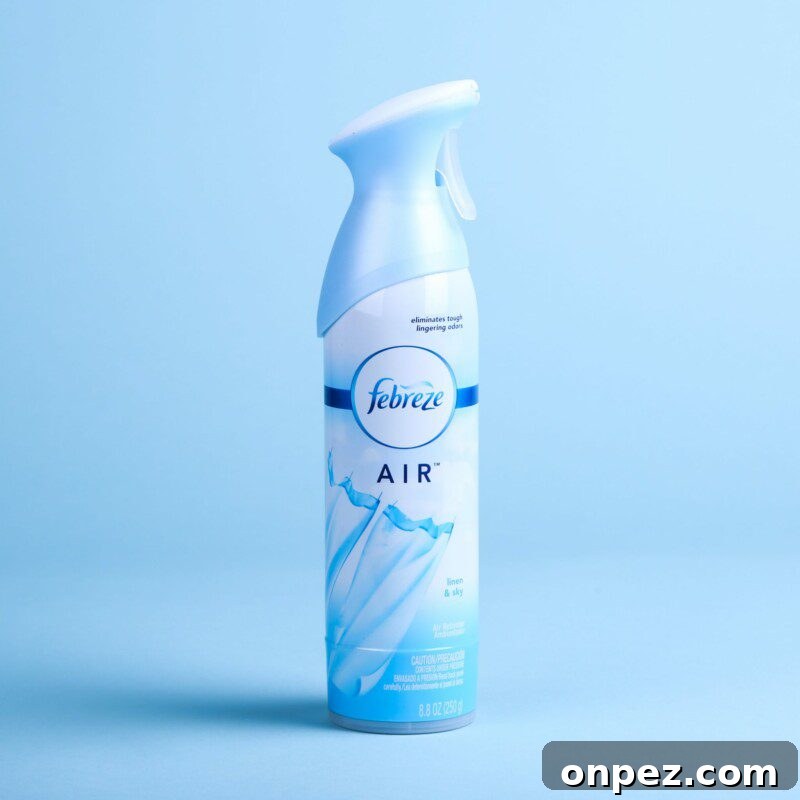
Back in 2009, the Environmental Working Group (EWG) published a report about cleaning products used in California schools that listed numerous airborne contaminants in a popular fabric spray. The original report is harder to find now, which raises questions about whether formulations have changed. Regardless, many fragranced consumer products have been found to contain carcinogens, allergens, volatile organic compounds (VOCs), and other concerning chemicals. That’s why it’s worth taking a close look at well-known air and fabric fresheners.
Table of Contents
- Is Air Freshener Toxic to Humans?
- Is Febreze Toxic?
- Febreze Ingredient Investigation
- Are “Light” Products Better?
- Are “Essentials” Sprays Non-Toxic?
- What About “Fragrance-Free” Sprays?
- Does It Contain Formaldehyde?
- Are These Products Safe for Pets?
- Safe Alternatives
- Other Non-Toxic Ways to Freshen Air
- Conclusion
Is Air Freshener Toxic to Humans?
First: these products do not clean the air. They mask odors with added scent or neutralizers, making a space smell fresher without removing the underlying sources of pollution. Second: regulation of fragrances, air fresheners, candles, and many household cleaners is limited. Companies can list “fragrance” without disclosing the specific chemicals used, and many ingredients face minimal safety testing compared with foods or medicines. Because of that, product labels and ingredient lists deserve careful scrutiny.
Is Febreze Toxic?
Independent scoring systems and environmental groups have rated certain household products in ways that suggest concern for some formulations. A quick look at typical product labels reveals mixed signals: several products advertise the absence of dyes, phthalates, or formaldehyde, which is positive. At the same time, standard precautionary warnings—like avoiding eye contact and not inhaling contents—remain on many bottles.
Febreze Ingredient Investigation
The brand offers many product types and scents, including fabric sprays, air sprays, car fresheners, plug-ins, wax melts, pet odor eliminators, candles, lighter-scent “Light” sprays, and collections promoted as using essential oils. Ingredient lists vary across products, but a representative ingredient list for a popular fabric refresher helps illustrate common components and concerns. Ingredients noted with an asterisk below are those that have been associated with potential health concerns in some studies or regulatory reviews.
Water
Water is the primary carrier and is safe.
Alcohol Denat.
Commonly used as an antimicrobial and solvent. At typical concentrations in surface and air sprays, it serves to help disperse other ingredients and reduce microbial growth. Not generally considered a health risk in diluted consumer products.
Hydroxypropyl Cyclodextrin
Used as a stabilizer and masking agent to help hold fragrance compounds. It is not broadly regarded as toxic in typical uses.
PEG-60 Hydrogenated Castor Oil*
Ethoxylated ingredients such as PEG variants can become contaminated during manufacture with trace impurities like ethylene oxide and 1,4-dioxane, both of which have been linked to health concerns. Because ethoxylated ingredients are widespread, completely avoiding them can be difficult. Reducing exposure where possible is a reasonable approach.
Diethylene Glycol*
Another ethoxylated or related solvent ingredient that raises similar contamination and toxicity questions when present.
Fragrances*
“Fragrance” on a label can represent many undisclosed chemicals. Some fragrance ingredients may be phthalates, VOCs, allergens, or endocrine disruptors. Because the exact composition is often proprietary, consumers cannot always assess risks from the label alone. Those with sensitivities or chemical sensitivities are particularly at risk.
PEG-11 Methyl Ether Dimethicone*
Another ethoxylated ingredient that can carry the same contamination concerns described above.
PEI-700*
Listed as an ethoxylated polymer; similar concerns about potential contaminants apply.
Didecyldimonium Chloride*
Used as an antimicrobial and quaternary ammonium compound. Some evidence suggests it may act as an asthmagen sensitizer for susceptible people, so caution is warranted.
Benzisothiazolinone*
A preservative known to cause skin irritation and sensitization in some individuals and capable of triggering contact dermatitis or worsening existing skin conditions.
Sodium Citrate
A benign salt similar to citrate from citrus fruits; generally considered safe in this context.
Sodium Maleate
A simple salt used for formulation stability; not typically flagged as high risk.
In this representative formulation, several ingredients raise potential concerns for long-term exposure or for people with sensitivities. Other Febreze product types, such as wax melts and candles, may include paraffin and synthetic waxes that release combustion byproducts when burned. Burning paraffin can emit a mixture of volatile compounds and particulates that some experts advise minimizing indoors.
Are “Light” Products Better?
Products marketed as “Light” or “mild” are intended for customers who find regular versions too strong. However, ingredient lists for these lighter formulations often look similar to standard versions and can still contain fragrances, ethoxylated ingredients, preservatives like benzisothiazolinone, and synthetic waxes. Without transparent disclosure of formulas and concentrations, it’s difficult to confirm meaningful safety differences.
Are “Essentials” Sprays Non-Toxic?
Some collections replace artificial fragrances with essential oils, which can be preferable for those avoiding synthetic fragrance chemicals. Essential oils still pose allergy or irritation risks for some people and are often accompanied by the same stabilizers and preservatives as other products. Because of those additional ingredients, these sprays can’t be universally labeled non-toxic.
What About “Fragrance-Free” Sprays?
“Unscented” and “fragrance-free” claims can be misleading—products labeled that way can still contain masking agents or small amounts of fragrance components. If a product explicitly omits fragrance, that reduces a major category of concern, but it may still include preservatives or ethoxylated ingredients that some consumers prefer to avoid. Always read the full ingredient list when sensitivity is a concern.
Does It Contain Formaldehyde?
Formaldehyde is associated with irritation and has links to certain long-term health risks. Some product lines are marketed as free of formaldehyde. In addition to free formaldehyde, some formulations may include formaldehyde-releasers; searching ingredient lists for common releasers can help identify that risk. In the samples reviewed here, no obvious formaldehyde-releasers were found, suggesting formaldehyde is unlikely in those specific products, though transparency and formulation changes over time mean consumers should check current labels.
Are These Products Safe for Pets?
Pets can be more vulnerable to chemical exposures because of their smaller size and different metabolism. Product labels commonly warn to keep products away from children and pets, and ingestion poses a clear hazard. Even normal airborne exposure can be more problematic for sensitive animals, so caution is advised. If a pet ingests any cleaning or fragranced product, contact a veterinarian promptly.
Safe Alternatives
There are many brands and DIY approaches that focus on simpler, more transparent ingredient lists. Options include non-toxic plug-in alternatives, plant-based room sprays, and odor-eliminating products that rely on adsorption rather than masking. Look for products that disclose full ingredient lists and avoid undisclosed “fragrance” whenever possible.
Other Non-Toxic Ways to Freshen Your Air
Rather than masking odors, consider approaches that remove or reduce sources of odor and improve air quality:
- Open windows to increase ventilation when weather and outdoor air quality allow.
- Use an air purifier with a HEPA filter to reduce particulates and some VOCs.
- Use odor absorbers such as baking soda or activated charcoal to capture smells instead of masking them.
- Dilute natural solutions like vodka or white vinegar in a spray bottle for linen and fabric freshening; add a few drops of an essential oil only if you and household members tolerate it.
- Keep surfaces and fabrics clean through regular laundering and vacuuming to remove dust and odor-causing residues.
- Advocate for fragrance-free policies at workplaces or shared spaces if chemical sensitivity is a concern for occupants.
Conclusion
Individual responses vary. People with asthma, eczema, autoimmune conditions, multiple chemical sensitivity, or other respiratory or inflammatory conditions are more likely to react negatively to fragranced products. Even for people without diagnosed sensitivities, breathing in products that contain carcinogens, VOCs, or allergens is not ideal for long-term health. Choosing products with transparent ingredient lists, minimizing use of fragranced sprays, improving ventilation, and using non-masking odor solutions are practical steps to reduce exposure.
Image Credit: Giorgio Trovato