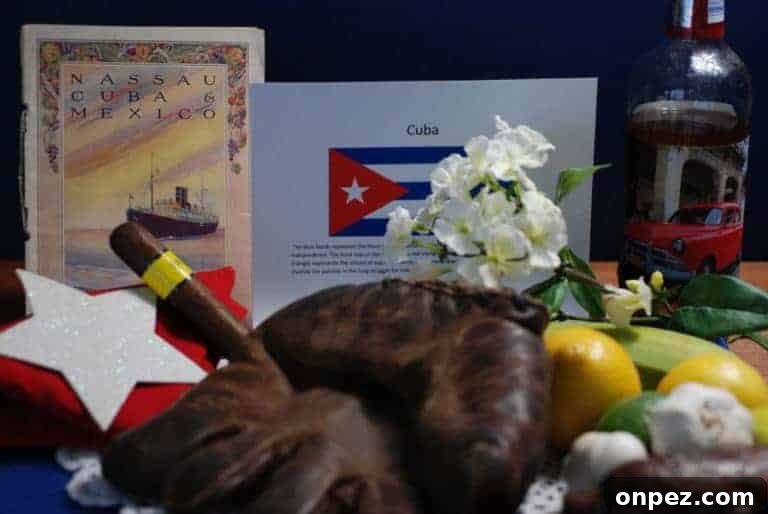
Exploring the food and culture of Cuba is a journey through history, music, family traditions, tropical ingredients, and deeply rooted hospitality. From the island’s Spanish, African, Caribbean, and Indigenous influences to its beloved dishes such as tostones, lechon asado, moros y cristianos, and churros, Cuban cuisine tells the story of a resilient and vibrant people.
Cuba takes its name from the Taino people, most likely from a shortened form of the word Cubanacán, often understood to mean “where fertile land is.” The country is a long, narrow island nation in the Caribbean, affectionately nicknamed El Caimán or El Cocodrilo because, from above, its shape resembles an alligator or crocodile. The Republic of Cuba includes the main island of Cuba, the Isle of Youth, and more than 400 small islands and cays. It lies about 90 miles south of the Florida Keys, around 125 miles east of Cancun, with Jamaica to the south and Haiti to the east. Cuba is the largest island in the Caribbean and one of the region’s most culturally influential countries.
Christopher Columbus arrived in 1492 and named the island “Juana” in honor of Queen Isabella’s son, but that name did not endure. Long before Spanish colonization, the Taino had migrated to the island from the region of present-day Venezuela, while other Indigenous peoples, including the Ciboney and Guanahatebey, also lived there. In 1511, Spanish forces took control and declared Cuba a Spanish territory. The Indigenous population was forced into labor, and many died from disease, overwork, and the severe disruption caused by European colonization.
As Spanish settlement expanded, enslaved people were brought from West Africa to work primarily in sugarcane and tobacco production. Tobacco became one of Cuba’s most famous exports, and Cuban cigars remain known around the world. Modern Cuba reflects this layered history. Its population includes people of mixed European and African descent, as well as white, Black, and Chinese Cuban communities. Spanish is the official language, and Cuban Spanish shares similarities with other Caribbean dialects, though Cuban speech is often recognized for its rhythm, warmth, and expressive gestures.
Cuba remained under Spanish rule until 1898, when the Treaty of Paris ended the Spanish-American War. The United States became heavily involved in Cuba’s affairs, and by 1902 Cuba had formally gained independence, although U.S. influence continued. One lasting result was the lease of land at Guantanamo Bay for a naval base, an agreement that was later extended. During the following decades, Cuba experienced political instability, dictatorships, and coup attempts. On January 8, 1959, Fidel Castro’s revolutionary movement overthrew the previous regime, and Castro presented the moment as Cuba’s first true independence since Spanish conquest.
After the revolution, Cuba became a communist state. This dramatically changed the country’s political and economic relationships, especially with the United States. Tensions led to the failed Bay of Pigs invasion, the Cuban Missile Crisis, and a long U.S. embargo that shaped Cuban life for decades. Cuba developed close trade relationships with the Soviet Union and later with Venezuela, but its dependence on these partners left the island vulnerable to global political change.
When the Cold War ended and the Soviet Union collapsed in 1989, Cuba entered a very difficult period known as the “Special Period.” The country lost much of its import and export activity, including vital access to oil. Transportation, agriculture, and industry were deeply affected, and everyday life became extremely hard for the Cuban people. Food shortages forced families to adapt quickly, using whatever ingredients were available and finding creative ways to grow, cook, and share meals.
One important development from the Special Period was the growth of organic and urban agriculture. With fewer pesticides and fertilizers available, many Cuban farmers and home growers shifted toward more natural methods. Vacant lots, backyards, and rooftops in Havana and other areas were turned into small gardens, grazing spaces, and community food sources. These changes helped support local livelihoods and gave many Cubans greater access to fresh produce, while also reducing reliance on chemical farming inputs.
Religion and public life in Cuba have also changed over time. Cuba is a secular state, and many Cubans identify with Catholic traditions, while others practice Afro-Cuban religions or follow no religion at all. Christmas became an official holiday again in the late 1990s in connection with Pope John Paul II’s visit. Cuba is also known for its high literacy rate and for a healthcare system that has produced many doctors. Cuban medical professionals have often been sent abroad to assist in times of need, and free healthcare and education are frequently cited as defining features of Cuban society.
Baseball is Cuba’s national sport and a true passion across the island. Public spaces are often filled with lively discussions about teams, players, and games. Cuba has long taken pride in its national baseball program, though the country has also faced the challenge of talented players leaving for opportunities abroad. The difference in pay between Cuban baseball and professional leagues in the United States has made this an ongoing issue.
For many years, Cuba operated with two currencies: the Cuban peso and the Cuban convertible peso, commonly known as the CUC. The Cuban peso was used by the local population for everyday necessities, while the CUC was often used in tourism and for imported or higher-priced goods. This system could be confusing for visitors, especially when comparing local prices with tourist prices. Currency practices have changed over time, but the legacy of a dual economy remains an important part of understanding modern Cuba.
Visitors to Cuba often stay in casas particulares, private homes licensed to host foreign guests. These stays can offer a more personal and culturally meaningful experience than large hotels. Food lovers also seek out paladares, privately run restaurants that often operate in family homes. These became legal in the 1990s and are now among the best places to enjoy authentic Cuban food. Paladares are known for home-style cooking, warm service, and dishes that reflect family recipes. Licensing is important, as Cuban hosts must be legally permitted to accommodate foreign guests.
The cuisine of Cuba is a flavorful blend of Taino, Spanish, West African, and Caribbean influences. The tropical climate and fertile soil provide fruits, root vegetables, plantains, citrus, herbs, and other ingredients that appear throughout Cuban cooking. Pork is one of the most popular meats, especially for celebrations, while rice, beans, yuca, plantains, garlic, and citrus are everyday staples. Cuban food is not usually fiery hot; instead, it emphasizes savory depth, brightness from citrus, and the comfort of slow-cooked dishes.
So let’s eat Cuban style:
The Menu
Appetizer
Tostones (Fried Plantains)
Salad
Ensalada Cubano (Typical Green Salad)
Main
Lechon Asado (Roast Pork)
Served with
Moros y Cristianos (Rice and Beans)
Sofrito (Base for Moros Y Cristianos)
Dessert
Churros con Chocolate Caliente (Fried Dough with Hot Chocolate)
We began the meal with a Mojito, the classic Cuban cocktail made with lime, rum, mint, and a cheerful toast of “Salud.” Rum has a long association with Cuba, and the Mojito is one of the island’s most famous drinks. It is also closely connected with Ernest Hemingway, who spent significant time in Cuba and wrote some of his best-known work there, including “The Old Man and the Sea.”
For atmosphere, Cuban music set the tone. Son Cubano is one of the island’s most important musical traditions, just as tango is closely linked with Argentina and samba with Brazil. Cuban music is widely admired for its richness, rhythm, and influence, and it adds warmth and energy to any Cuban meal. The sounds of guitar, percussion, and voice immediately bring the spirit of Cuba to the table.
We decorated the table with the colors of the Cuban flag: red, white, and blue. We also included images of old American cars, one of the most recognizable sights associated with Cuba. Because many vehicles on the island date from before 1959, Cuban mechanics and owners have become remarkably skilled at maintaining and restoring these vintage cars. They give the streets a distinct character and have become part of Cuba’s visual identity.
Our first course was hot fried plantains, better known as tostones. They are best enjoyed fresh from the fryer, while the edges are crisp and the inside remains tender. Tostones are a popular Cuban snack and appetizer, usually served simply and enjoyed with family and friends. Their mild flavor makes them a perfect beginning to a Cuban meal.
The main course was served family style, just as Cuban food should be. Lechon asado, or roast pork, was paired with white rice and black beans cooked with sofrito to make moros y cristianos. The combination is deeply satisfying, with the savory beans, fragrant rice, and rich pork balancing beautifully. A simple Cuban green salad with citrus and garlic dressing added freshness and helped cut through the richness of the meat.
Lechon asado is often prepared for special occasions. Traditionally, a whole pig may be roasted in the ground and covered with banana leaves, though roasting boxes have become a popular alternative in many Cuban communities. What makes the pork unforgettable is the mojo marinade, a bright and bold blend of citrus and garlic. The marinade tenderizes the meat and gives it a distinctive Cuban flavor that is both fresh and deeply savory.
For dessert, we enjoyed churros with hot chocolate. Churros are strips of fried dough rolled in sugar and served with a cup of thick hot chocolate for dipping. They are simple, indulgent, and impossible not to love. After a meal of roast pork, rice, beans, plantains, and salad, churros made a festive and comforting finish.
The cover image includes a pamphlet titled “Nassau Cuba & Mexico,” written by Zane Grey for the New York Cuba Mail Steamship Company. It is a rare piece from a treasured Zane Grey collection, along with his diary from that trip. In 1909, Grey described Havana with admiration: “Havana is a magnificent city of white-walled avenues, of green-foliaged plazas, of gray-towered cathedrals and monasteries; and its wonderful coloring runs sheer into the blue waters of the harbor. It is bright, attractive, full of life. Tourists of all nations are there giving the city a cosmopolitan atmosphere. A walk or drive down the Prado from Central Plaza to the Malecon is one of the most enjoyable that can be imagined. Streams of carriages and automobiles, going and coming, giving an air of New York or Paris.”
As we leave Cuba in spirit, we do so with respect for its people, its history, and its extraordinary culinary traditions. Cuban cuisine is more than a collection of recipes; it is a reflection of resilience, resourcefulness, and joy. From a casa particular to a family paladar, from a simple plate of rice and beans to a celebratory roast pork, the food of Cuba offers a meaningful way to understand the island’s culture.
Until next week,
Warmest Regards,
Darlene
P.S. Wondering what to do with leftover roast pork? A Cuban sandwich is the perfect answer.
Cuban Sandwich